RHYMES&REASONS

Observations, Thoughts and Reflections on 21st Century Life

N.E.W.S – Parallel Time

North. East. West. South.

Instant. Happening. Plus one and real time,

Parallel worlds and lives which don’t chime.

Twenty four seven, channels to choose

Inward we turn, money to loose.

Pools of champagne, pools of blood,

Encroaching. Unwanted. Drought and flood.

Which world is mine in parallel time?

Reality TV talent to spot,

TV for real – someone is shot.

 Christmas delivered, targets to meet,

Harvest failed, kids in bare feet.

Toy penguins emote season’s first frost,

Polar melt – the arctic is lost.

Which life is mine in parallel time?

 Big Brother House. Ok! Hello!

Charnel house, Sierra, Aleppo.

White House secrets outed old lies,

Foggy Jungle King, Malala Peace Prize.

No arms, no legs, no head to crown,

Bloody Sunday; Cyber Monday death in town.

 Which conflict is mine in parallel time?

North. East. South. West.

Lives of celebrities to whom we aspire,

 Suicide bombers few can admire.

Knives quick to draw, turkeys to carve,

Minors in designers . . . others will starve.

Action man sold out. Tragedy! Child cries.

Boy soldier shot. Tragedy. Stumbles and dies.

The choice is mine in parallel time.


Orgasm of the Mind

In my time alone my life happens.

I’m at my most peaceful sitting in dappled shade, the dancing of the shadows reflecting my thoughts as they skip between the light and darker corners of my mind.  This dipping in and out is the intercourse of creative life – the place where ideas are conceived, nurtured and born; where conversations take place without saying a word.

Reflection, thought, solitude and contemplation.

Words which seem to jar and sit ill at ease with 21st century vocabulary, which in order to be heard above the mayhem of tweeting, trending and texting would need to shout and present themselves loudly, the very antithesis of their meaning.  They are unfashionable words, the execution of which is seen as odd or eccentric.  And yet we should cherish and practice them at every opportunity. Until 50 or so years ago it was only the elite who had time to stand and stare but now with so many labour saving devices in the average western home we too have that luxury if only we choose to embrace it.  Instead many of us fill those disposable hours with online activity, encouraged to put ourselves forward, to shout the loudest and follow the latest viral trend or else we have somehow failed . . . the irony of which as I type this post is not lost on me!  We have ceased to become self-reliant, choosing instead to escape into this world of hyper-activity in preference to our own company.

And yet it is a precious thing, to be still and reflect, to explore our thoughts away from the influences of the external world.  To be self-reliant is to breed tenacity, the will and self-determination to follow our own path when those around us are walking the other way.  It develops imaginative curiosity to seek out answers for ourselves rather than an easy following of the crowd.

And it takes courage to be different.

To be alone and not defined by someone or something else, to avoid being influenced by outside things – this is what creates strength and individuality.  We live in the age of individualism and yet, in reality our world is strictly regulated and the individual is merely on a treadmill that keeps the social template moving. It is only by removing ourselves from the system – however briefly – that we are truly ourselves; to be brave enough to navigate our own path is to develop the ability to re-engage more intensely and purposefully without risking loss of identity.

If we dare to withhold from immersive over-sharing and delve into speculative thought, we may be rewarded with creative inspiration, the courting of a fresh passion, the desire to perfect a new skill and the exquisite experience as it all comes together into something tangible.  It can afford you one of the greatest pleasures of all – what Michael Foley in his excellent book ‘The Age of Absurdity’ refers to as the orgasm of the mind.

To be actively individual is not passive or reclusive, rather it is like standing back from a painting in order to see it more clearly.

And it is from here that we may find our purpose and thus our meaning.

 Quiet Contemplation

‘Quiet Contemplation’

Rebecca Pells    2014

True Saying by Albert Einstein

The Circle of Life

Green eyes dilute with age, my feline friend conveys a dignity far greater than mine.

A pull bonded by years both knowing it will end, at least in this physical realm and time.

Preparing for what I know must come and yet, part of my destiny too.

Sharing these last hours although different than I, the magnetic tug endures, not to be parted from you.

And yet I must let you be free.

She senses my sadness, how hard to let her go but with an unspoken ‘it’s okay – this is the way it should be’.

This circle of life.

I leave her to sleep, to choose her own time,

But my desire to be near I gently disturb, gathering her weak body warm, close to mine,

her plumpness diminished revealing the curve of her ribs and contour of spine.

I drink in the sweet smell of fur a memory to recall at some distant, unimagined time.

Her purr once given so freely now comes raspy with effort but offered  to reassure.

Still she gives more.  My precious one.

  No longer able to lazily stretch, white tummy exposed to enjoy the May sun

but lying sphinx-like a position to endure, five minutes or more.

The birds once prey now chatter and chirp, keeping a distance borne of respect.

Do they too sense her gathering end?

The pure joy of having known and shared a love.

Emotion  poignant with loss, etched with privilege of witnessing life waned

and laced with the inevitable sadness to come.

The circle complete.  My precious one.

A Sense of Un-Belonging

006

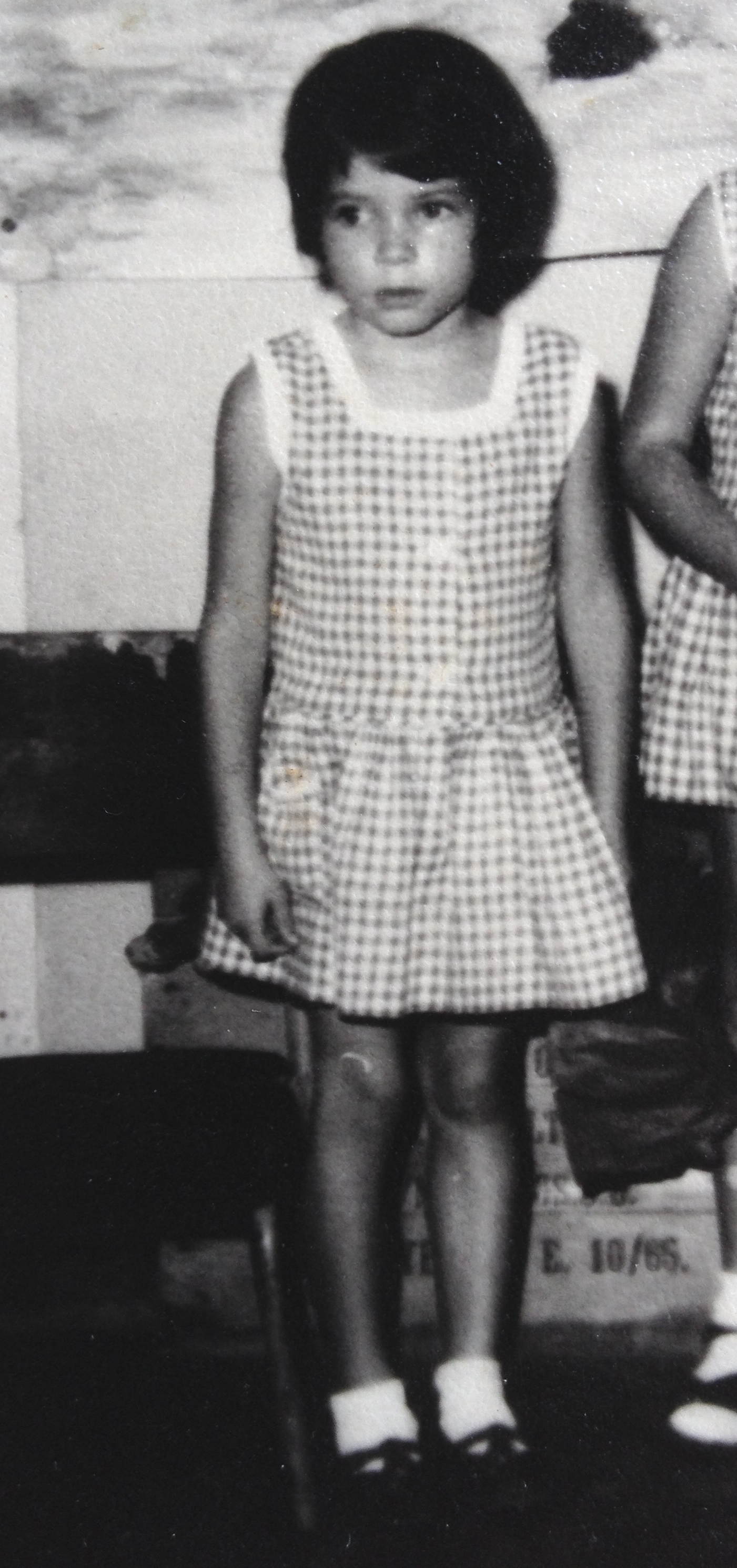
Singapore 1966

Am I to be forever on the outside looking in? It has become a place – a feeling – so familiar, that I now fear the very thing I seek.  I carry it with me and yet it doesn’t have form, this nebulous  thing;  I cannot grasp it, and yet I can feel it’s elusiveness.  I have looked for it in my home, work, relationships and among my things.  I have few items from my family home –  they should evoke a warmth of feeling, a welcome symbol of my belonging somewhere but I find none, only a physical ache for something lost – no for something I’m yet to experience: an ongoing penance for daring to be here at all.  It’s not my destiny, it is and always has been my reality, the outsider as one country became another and I learned to count the number of schools in different languages.  Letters sent to best friends who’d formed new allegiances before the postmark had dried.

For a moment, I felt I belonged to something or someone, I wasn’t sure.  It was a feeling unfamiliar despite my one score year and ten. It was only later with divorce papers in hand that I realised I hadn’t belonged at all, I’d wanted it so much that I believed for a while only to discover I’d found something different, an identity that didn’t even begin to fill the void.  I’m trapped in this waiting game, on the outside while everyone else is within, strangely similar to my childhood punishment of being left out in the hallway while the rest of the family were in the sitting room with the door firmly closed.

And so I find myself on the outer edge of others’ comfort zones, kept in some kind of friendly exile as they perceive my differences.  Or perhaps it is I who perceive them, me that does not know how to fit in.  The roots of belonging are established in childhood and strengthen as we mature.  If for some reason this fails to happen, I have come to accept, at least for me, that it will never do so.  A sapling starved of essential nourishment, continuously uprooted and replanted in new territory every few years will struggle to thrive,  it’s energy channelled into mere survival, unable to blossom or reach it’s full potential as a mature tree.  It will never have the stability of it’s contemporaries, it’s roots exhausted by constant disturbance have little strength to weather the next storm.

Unlike the tree, I can choose my environment and find shelter from stormy weather and in the calm of my simple life I can thrive and flourish, untethered by my un-belonging, abiding by society’s rules but unbound by it’s conventions. There is a freedom to this existence from which I can emerge at my choosing.  In this existence I can create my own place unrestrained by outside expectation and dictates.  I’ve ceased to seek this thing called belonging – the need, the void is still there but I have learned to carry it not as a burden but like a warm coat.  There is now a comfort in not belonging, a familiarity I would miss.  I can finally embrace being on the outside looking in, not in judgement but with a welcome sense of reflective clarity that is borne by detachment as a gift.  These are the desired nutrients for the flourishing of creativity and unfettered freedom to blossom.

003

Acrylic on Canvas 2014 Rebecca Pells

Quantum Leap – the Connection between Darwinism and Climate Change

Image

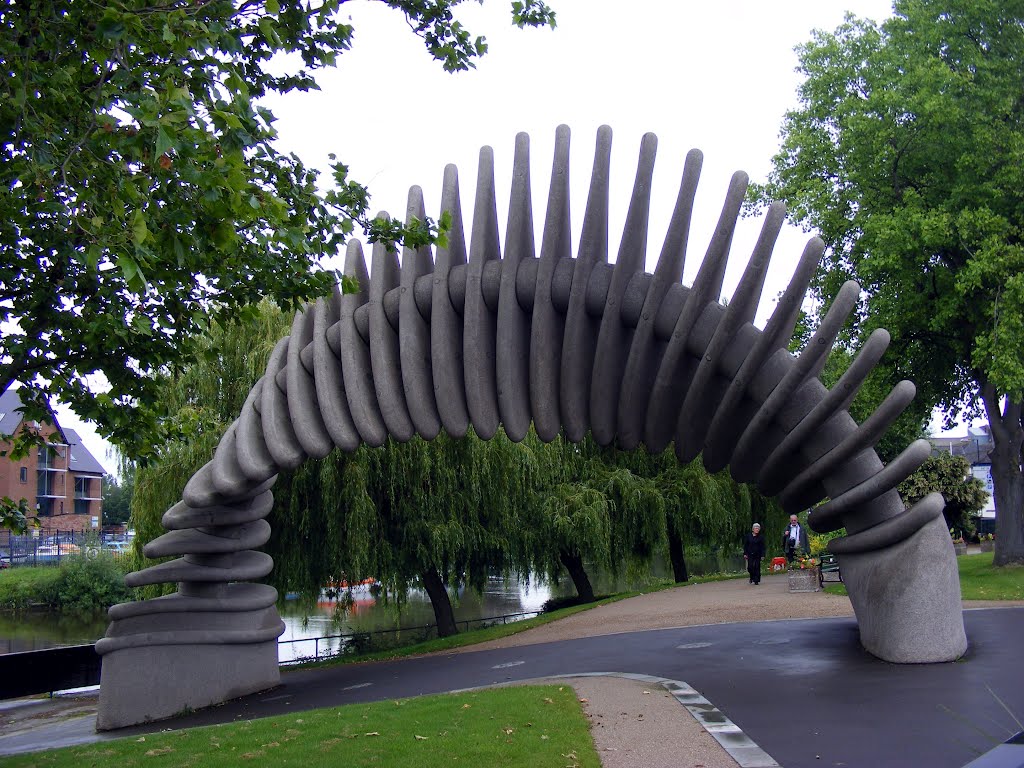
The above image is of a sculpture called Quantum Leap which sits on the banks of the River Severn in my home town of Shrewsbury, UK.  It was installed in 2009 to mark the bi-centenuary of Charles Darwin who was born here and educated at Shrewsbury School. It represents the great move – or leap –  forward that Darwin’s work made in our understanding of ourselves and the natural world.

Below is my own photograph taken yesterday in which the sculpture appears to be diving into the swirling flood waters of the swollen river following weeks of rain-fuelled storms.  I took the picture from the terrace cafe which hugs the side of the Theatre Severn on the opposite bank – what you cannot see are the flood barriers erected some weeks ago to assist the exhausted river to keep within it’s banks and heave it’s watery burden downstream.

008

It was with a wry smile that on the first bright sunny day for weeks I attended the annual Darwin Lecture at the theatre given by Joe Cain, Professor of History and Philosophy of Biology at University College London.  His subject was ‘The Scopes Monkey Trial of 1925 – Reality or Fiction’.  John Scopes was put on trial for teaching evolution in an American secondary school in Tennessee and it marked a pivotal moment in the conflict between religion and science.  However, the main point of the trial was to test the law and in so doing, raise the profile of the creation-evolution controversy.  “It was” Cain said  “essentially a story of denial which became a story about people”  –  the charismatic heads of both legal teams, politicians and even celebrities jumped on the band-wagon.  The event was exploited by these people who used it to build interest in and also to create agitation about the issue, to suit and further their own individual aims.  In so doing positions became deeply entrenched as each person added a layer to the argument creating an ever greater divide and making agreement appear impossible.  The scientists were asking the fundamentalists to have faith not in God’s creation but in scientific fact.  It was indeed a quantum leap and it didn’t happen overnight.

The debate around climate change seems to be playing out in a similar way, although there has yet to be the circus of a high profile trial!  The ‘layers’ are piling up – the politicians are certainly in the main arena (if only they’d been in it some ten or twenty years ago) vying to highlight differences between their own stance and that of their counterparts.  Celebrities falling over themselves to identify with one camp or another, scientists divided by those who believe we are causing global warming and those who think it’s a natural occurrence.  In the 1920’s skepticism was understandable as science and technology was generally associated with bad things such as the new weaponry used in the Great War.  Today, despite our familiarity with and dependence on science and despite the growing volume of evidence pointing directly to climatic change, still we demand some final piece of irrefutable evidence.

What will convince us to take action, what are we waiting for?  To arrive at some nebulous horizon of climatic horrors, at which point we will blame scientists for not providing a solution?  It is unlikely there will be one great catastrophic event that announces the arrival of climate change – it is already here, revealing itself incrementally, in fits and starts but with increasing persistence.  Professor Cain concluded his lecture with a reminder that even today there are countries which deny Darwin’s theories and in which evolution is not widely taught.  Pakistan is one such country – it’s also a land which in recent years has suffered serious flooding far greater than anything we have yet to experience.

There seems no reason for us to deny climate change other than a perception that to acknowledge it will involve the end of life as we know it.  Just as with the creation-evolution wrangle, believing in one does not mean you have to totally reject the other.  You can practice a religious faith and ascribe to evolutionary theory.  The two are not incompatible.  Evolution has shown that nature never stands still, it adapts to it’s surroundings to ensure survival.   Now it’s our turn, we don’t have to renounce modern life in it’s entirety but we do need to adapt to our changing environment just as our ancestors did.  We have the intelligence and the science and the advantage of global communication.  Is it such a quantum leap to find the wisdom to apply these in unison?

Global Government, a Nice Ideology – or a Brave Way Forward ?

I’m fascinated by how humans have evolved and progressed and their relationship to the environment. Without this knowledge how can we begin to understand our current situation let alone how to move forward with equity and compassion for each other and the planet? It’s like a huge Maypole – planet Earth the pole, standing strong; the ribbons are nations, each fringed by sub-cultures, belief systems and political and economic structures which have developed over centuries. Unlike the May dance which is planned and choreographed, these ribbons of civilization had no blueprint and stepped out according to will, clashing and entwining with one another until they have become inextricably linked in one almighty tangle.

Now we have this great global knot placing intolerable strain on the environment which threatens to topple the delicate balance of the pole itself. How can nations, with their various historical and contemporary complexities, come together to ensure quality of life for all citizens, wildlife and the environment? How are finite resources, faced with increasing demand, to be shared? Our scientists overwhelmingly concluded last week in the IPCC report that climate change is real and whether or not we agree on it’s cause, we have to adapt to a warmer future.  As nations rush to protect and secure their own economic destinies through the promotion of consumerism and engagement in 21st century empire building, how can we make sense of and ease this worldwide tangle enabling us to move forward with equity?

Is there now a case for serious consideration of some kind of global ‘government’, whose members forgo their nationality to become citizens representing the planet ?  The challenges we face are demanding and the urgency to forge something healthy and sustainable serves only to intensify my passion to engage in a new and enlightened way forward.  We only have to look to the Easter Island story as detailed by Jared Diamond in his fascinating book Collapse, to see how easily a civilization can determine it’s own demise through failure to acknowledge facts and adjust it’s way of life accordingly.  Humans have a resistance to change, it has either happened slowly over generations or dramatically through war, disease or environmental ‘disasters’ , but we are surprisingly adaptable. For the first time in history, we’re aware of what is happening across the planet and we have the knowledge to predict what the likely outcome will be if we continue to tread the path we’re on.  But this also gives us a great opportunity to make wise choices.

Global government, a nice ideology – or a brave way forward ?

Autumn


021


Autumn is a time for letting go of that which we can no longer hold onto.

Preparation for a bare winter when little appears to change and all seems lost as we mourn the sweetness of a summer past.

Long days of darkness hang upon us but we know that given time, eventually the light will return once more, gently breaking through our sadness, lightening our mood. The groundwork of autumn has cleared away the spent and decayed in preparation for the sweet shoots of new life and possibilities.

And we know that we will move forward once again unburdened by what has been.

Knowledge, Intelligence and Wisdom

Two weeks ago the New Birmingham Library was officially opened by Malala Yousafzai.  It struck me that this 16 year old girl, thrust into the limelight following her fight for education in her homeland of Pakistan, already displays the hallmarks of wisdom.  Having visited the library last week, I cannot deny that it is a wonderful facility, crammed with information gathered, written and published through previous generations and which can now be accessed in any number of traditional and technical ways.

As time goes by and our understanding of the world expands, new discoveries are made and life becomes increasingly complex, so does the amount of knowledge recorded, shared and passed onto our children.  Each generation has to start at the beginning to learn the basics and despite increasing years spent in formal education, most of us can only hope to ever reach the lower echelons of the pyramid of knowledge. Our way of handling this overwhelming amount of information is to specialize and become experts in one tiny sphere and as such our outlook on life is forever skewed by our lens of choice.  When faced with challenges beyond that field of vision we believe it is not our problem, that someone else will have the knowledge to fix it and we relinquish any sense of personal responsibility.

How we record and share copious amounts of knowledge is one thing,  but for me the moot point is whether our propensity to spend greater amounts of time in formal education is producing the collective wisdom required to tackle the global challenges of 21st century life. Just 80 years ago in the so called western countries it was the norm to leave school at 14; today many are studying well into their twenties and yet the evidence that this has produced an equivalent increase in wisdom is not obvious. If we look at those individuals whose actions have had positive benefits for large numbers of people – Mahatma Ghandi, Martin Luther King, Nelson Mandela – they are few and far between, perhaps one or two per generation.  None of them benefited from extended formal education and yet arguably they displayed a wisdom most of us are in awe of.  Can such wisdom be taught in a classroom or is it something which is innate in a few individuals and which given the opportunity, will propel that person to act for the greater good?  Do they perhaps view the world through a wide angle lens rather than one which has narrowed it’s focus?  In trying to increase our knowledge with unprecedented amounts of information are we actually overloading our minds and cluttering our ability for clear and wise thinking?

In an era which has for the first time in history enabled us to be acutely aware of global issues, does the forum and delivery of knowledge and the nurturing of intelligence require a different approach?  The encouragement of modern individualism seems at odds with the challenges which need addressing in the 21st century.  In Malala maybe we are witnessing one such wise individual but it seems we are far from knowing how to harness, share and encourage a collective wisdom.

Why a Decade of Debris is Good for Your Spirits

015

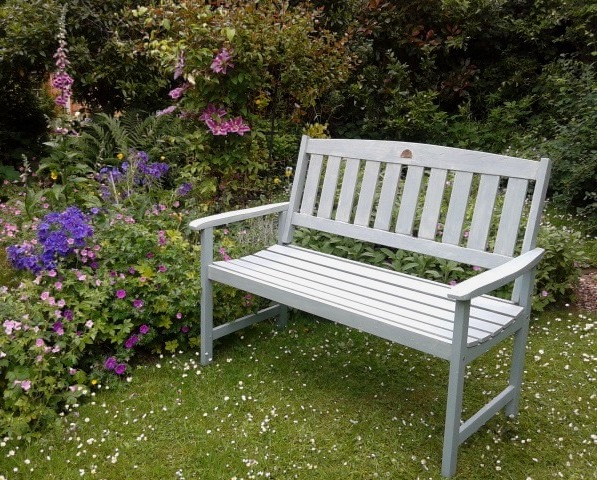
For the last three years I have observed my garden bench as it morphed from an often used, aesthetically pleasing addition to my garden into a drab collection of wooden slats, in danger of being claimed by a snaking wild bramble. By last summer I utilised it rarely, due in some part to the dismal weather but largely because my once favoured place had become a neglected corner,  visited only by local cats to sit for a quick wash after which even they declined to linger more than a few minutes before departing in search of a more comfortable spot.

Purchased some fifteen years ago, the wood had long since lost it’s natural beauty, fading gradually from a rich cedar tone to a silvery hue quite charming and delightful, before subsiding to a dull dark brown, stained by time and nature.  After the first few years I failed to cover it in the autumn but still expected it to to flourish with welcoming comfort the following spring.  With the first appearance of cracks I gave the bench the attention it was calling for in the form of  linseed oil applied with an old rag, which it consumed like a hungry child giving it a healthy glow once more, the affect of which lasted but a few months and provided little sustenance to see it through the cold, wet winter.  Tree branches overhung the seat providing welcome shade from occasional burst of strong sun but were also a favourite with the birds.  It soon became a chore to clean the bench before it was habitable and gradually I didn’t bother and somehow this previously cherished place in my garden had become an eyesore and it in turn stared resentfully back at me.

Finally, I have taken notice.  And what a journey we have been on: half a dozen sheets of coarse sandpaper to remove a decade of debris, along with several hours of elbow grease.  No electric sander for me! If this effort was rewarded as the colour and grain of the wood revealed itself once more, it was surely the gentler application of fine sanding that helped it glow with life.  The benefit of this transformative action was not for the bench alone; for me the physical effort blended with the creative activity – taking one thing and through a series of processes discovering  another – is one that cannot be matched for pleasure, satisfaction and achievement.  It distracts from the ever present background ‘noise’ of the mind, taking you deep into the present moment where worries about what has been or what might be, do not exist.  It’s the reason art therapy is offered as an alternative to drugs for those who are strugglimg with anxiey and depression and I was witness to it’s gentle transformative effect when I worked in a centre which used anthroposophical therapies, including art, for people with long term health conditions.  The reason it works has little to do with the end result but much more the process it takes us through, allowing the mind to gently find a way free of the unhealthy groove it habitually remains stuck in.

I do wonder, if we engaged with activities which have an underlying creative experience on a regular basis, whether it would promote a healthier, more satisfying life experience. So much of modern life is stripped of the opportunity to strive, experiment, experience and feel, make mistakes, get it wrong and spend time finding a solution.  From mass produced goods, where imperfections result in a ‘return for our money back’ attitude rather than seeing irregularity as the signature of the craftsman; from the preference for uniform supermarket produce  over  the knarled vegetables which, freshly dug from your garden and sweet smelling are proudly presented on your plate.  The digitally produced music to which our ear has become accustomed but fails to quite move us in the same way as the old vinyl and the photographer who enhances the image in order to please the constant demand for perfection, belying the truth he witnessed and perhaps too his own sense of satisfaction.  In this manipulated and ‘perfect’ world how can we hope to be truly connected to the reality of life – are we not by default always one step removed? Could this be the reason for the modern ‘dis-ease’ of vague disatisfaction that so many of us experience yet can’t quite put our finger on why? It is as if much of modern life has been stripped bare of the very things which nourish the soul and maintain a healthy equilibrium.

I could have ditched my bench in favour of a new one, the buying of which may have provided a moments pleasure.  But I figured that one tree had already given it’s life for me to have a comfortable place to sit in my garden and with a little work and attention it would provide me with a good few more years. After some deliberation I decided to paint the bench in the hope of protecting it a little longer.  A once mass produced item has now become something personal, complete with imperfections and nuances and a history all of it’s own with which I am now uniquely and intimately bound.