RHYMES&REASONS

Observations, Thoughts and Reflections on 21st Century Life

Embracing Vulnerability – take the risk and do it anyway!

To be vulnerable is to experience our own humanity.  It is a place we reside, where we are tenderly cradled and touched by our very essence.  In an age of tweets, updates, blogs and other portals of instant digital exposure, we are encouraged and seduced into sharing details of our lives.  Our vulnerability stands at the threshold of our inner deep desire for acceptance and affirmation and the outer, shallows of exposure.

Creativity is the metamorphosis of our inner world to the outer.  Our vulnerability is on display along with our words, paintings, sculptures and photographs.  Ideas originate in the depths of our being,  inhabiting a private nurturing world before eventually the desire to transform the nebulous into something physical inspires action and the artwork is born.  Projected into the daylight,  we are not simply exposing our physical being but that delicate, unprotected and naked vulnerability which shies the limelight and seeks shadowy refuge at the merest hint of criticism or indifference.

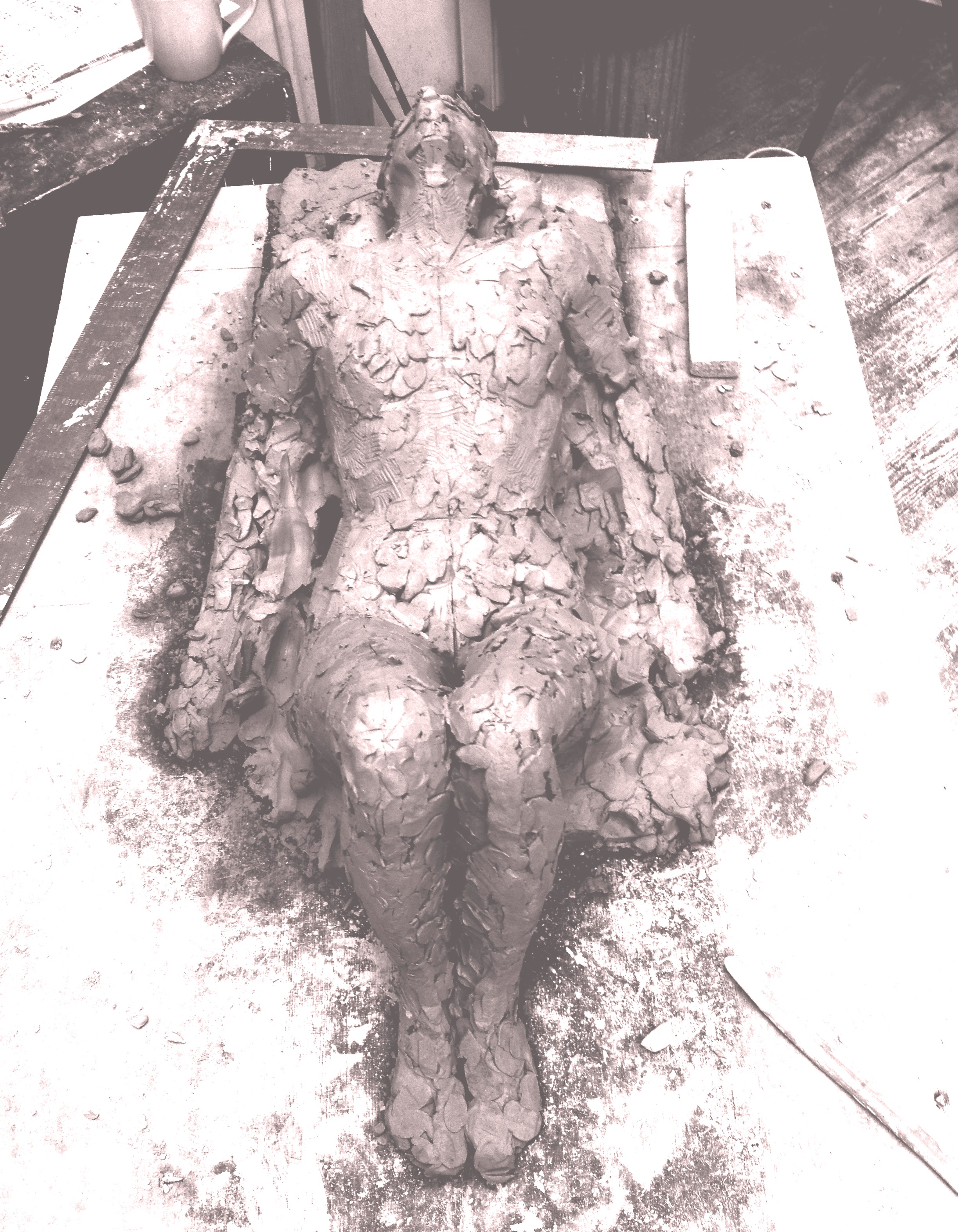
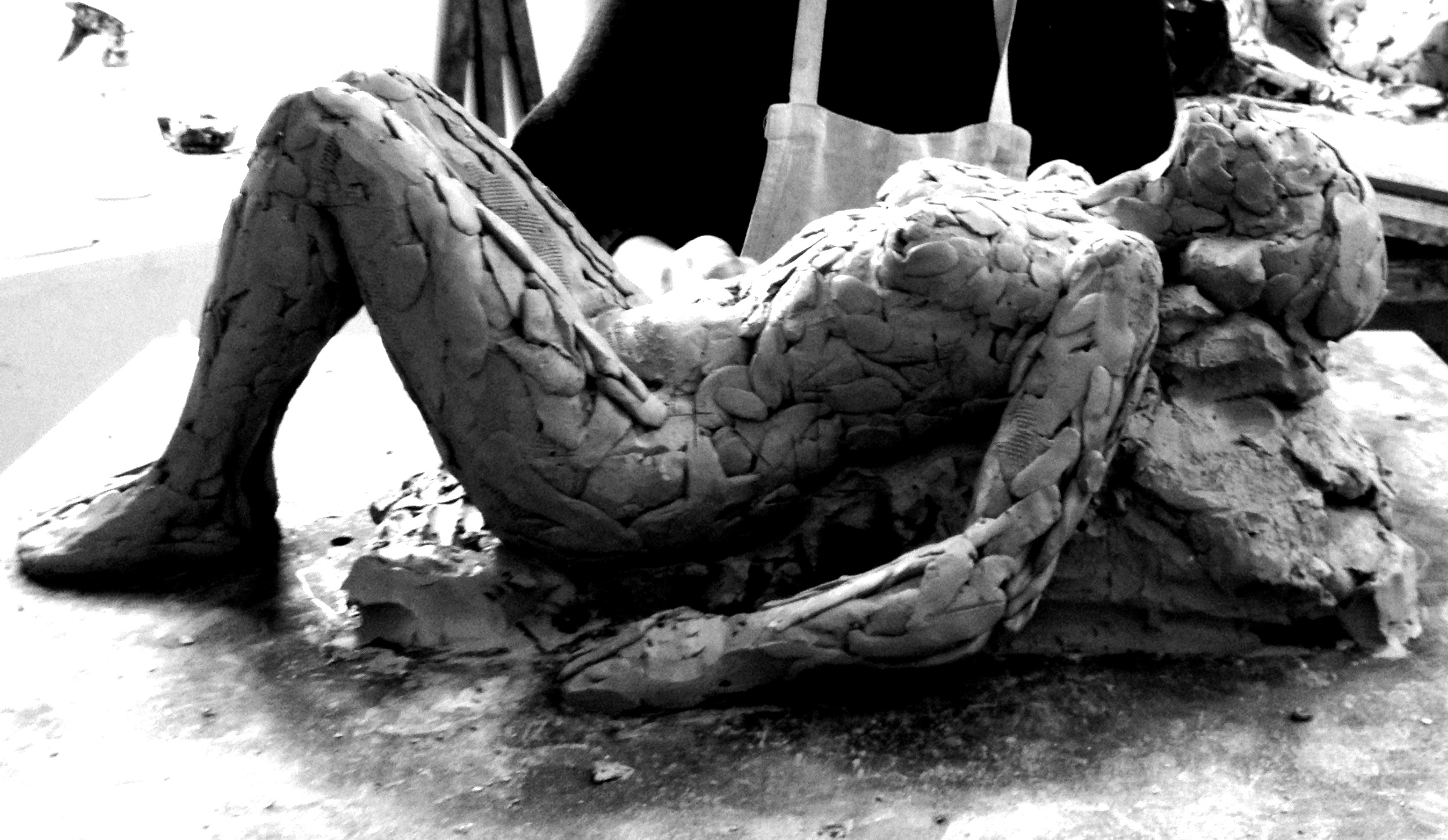
I recently spent five days on a sculpture course at Stanton Group Studios.  It was my first experience as a life model and  what I thought would leave me vulnerable and exposed quickly began to feel entirely natural.  It is only in the crossing of the threshold from the comfort of familiarity into the unknown that we experience vulnerability. We can step back in fear or stride into a new horizon just waiting to be explored.  For me this experience was far less exposing than when I publish an article or enter a painting in an exhibition.  Modelling shares only the outer self whereas the others come from a place deep within, revealing something of the vast, private interior, offering up tender shoots easily crushed by rejection, ridicule, judgement and jealousy.  It is tempting to recoil but in so doing we also close the facilitating portal to appreciation, admiration, respect and regard.

To seek vulnerability is liberating; it faces the biggest fear of all – that if others knew what we inwardly harbour, what we are really like, they would avoid us.  And yet the most attractive and interesting people are not those who look amazing or produce the greatest work – they are the ones who are confident in spite of their imperfections.  They are the ones who are willing to face rather than fear vulnerability knowing through experience how freeing and empowering it can be.

Many of us resist risk and change be it of ourselves or in others.  An attempt to be invulnerable is a vain one; it is part of our intrinsic nature and encompasses courage and compassion.  The choice we have is not whether we are vulnerable but to live with it bravely and with courage step fully across the threshold.


ro

Rob Ackerley Sculptor   robackerley@me.com

The Burden of Choice

      'The Writing Table'    www.rebeccapells.co.uk

‘The Writing Table’
http://www.rebeccapells.co.uk

Since the middle of the 20th century choice has become the cobweb in which western society resides.  The driver for consumerism and chief supporter of capitalism it is the meeting point of commerce, politics and our personal lives. The axis around which we chase perfection and happiness as along with the goods, we buy the idea that choice is desirable.  Choice has become synonymous with freedom – freedom to exert our preferences and spin a life exactly as we wish it to be.

  Expectations are raised and goalposts moved as we succumb to the intoxifying lure of possibilities.  But too much choice can leave us overwhelmed, saturated with options and oppressed by the burden to make the right decision.  Freedom becomes our jailor as complexity leads to paralysis and fatigue.  Too much information and too complex for us to be confident we are making the right choices; at worst it leaves a trail of anxiety that we may have got it wrong and at best a background sense of dissatisfaction that we may have missed something better.  The thrill of possibility turns to tedium, procrastination, exasperation and ultimately despair of ever achieving our goal and we may in the end withdraw from engagement altogether.

I experienced this first hand last week, spending days at a time staring with increasing chagrin at my computer screen as I attempted to work my way through the hundreds of options and variables a I constructed my new website.  More than once I was ready to give up – the sheer volume of decisions I was ‘forced’ to make was overwhelming.  Convinced that I might miss ‘the one’ I spent hours scrolling through hundreds of font styles, sizes, UPPER/lower case, bold, italic, underlined, custom –  the options were infinite.   The anticipated creative experience turned sour and it was only when I took a step back from the keyboard and revisited my original goal – for a clear and simple site to showcase my paintings –  that in the end I took control and returned to the essence of my desire.

Surrounded by the vicissitudes of life we hinder further our progress by allowing unnecessary complexities to seep in and saturate our daily lives until the picture has become so blurred that we loose sight of our original horizon.  We literally feel swamped by the flotsam and jetsam of choice and anchored down by indecision.  The 21st century will not leave us alone, it will not hold back the tide of modernity.  But we can discipline ourselves to surf the waves of amebic decisions and only roll with the important ones.  We have the ability –  the choice – to live our identity unburdened by minutiae and from place where we bear witness as if for the first time.

*

For more examples of my art visit http://www.rebeccapells.co.uk

The Child of Fear and Grievance

The temperature of nationalism has been on the rise in Europe since the beginning of this century.  This week it came roaring it’s way over the threshold of the UK parliament seating itself firmly in the chambers of power.  The middle ground is being pulled to the outer edges of fear and grievance.

At best nationalism is an invitation for the unwelcome guest to return home; at worst the exorcism of an unwanted presence in our homeland.  We struggle to let go of the way we have decided to tell our story, embellished by time and enmeshed with grievance it provides us with a sense of belonging.  Nebulous and lacking definition it longs for incarnation and roams with intent, seeking the portal of increasing support through which it can transmute and manifest.  At the same time we are not quite knowing or recognizing the form of our intention.  We explore the streets of our political landscape looking for firm ground but finding only rough terrain which keeps us off balance and unsure.

 Instead of choosing to let go of the foundational memory of those we were wronged by, a false sense of self enables a collective pain to thrive and breeds fresh fear of a contemporary but false enemy.  We cease to be afraid of our neighbours when we cease to carry the collective fear and injustice of our past, choosing instead to make friends with those we previously challenged with a beckoning hand to our future.  To let go is to enable ourselves – our nation – to see our place in the world more elementally and clearly.  It is to unburden ourselves from carrying the past and lighten the load, sweeping away the black cloud of history which was passed down to us and – without such bravery – we will inevitably pass to our children.

Withdrawal from the front line of demand and grievance enables us to realign and find a fresh perspective, viewed through a contemporary wide angle lens rather than the myopic glass of selective and painful memory.  It is only from here we will find solid ground from which to step forward in friendship and have our voice heard in a different, clear fresh and powerful way.

*****

You may also be interested in an earlier post  A Sense of Un-Belonging.

To deny or not to deny . . . to be in denial is considered a negative but is it?

Denial is a natural reaction to anything which may cause us discomfort or distress, to that which we did not seek – illness, loss of a job or relationship.  It’s a form of rejection of participation in what is.  Often viewed by others through a lens of negativity and accompanied by an underlying current of judgement, someone ‘in denial’ is perceived to have failed one of life’s many tests.

But denial has a role.  We find ourselves catapulted into no man’s land, somewhere between the longed for safety of the familiar past and the resisted, feared future.  Shell shocked, our senses heightened and with eyes clouded by confusion, we scramble to return to the safety from whence we came, only to feel the ground give way beneath us.  The more we try to no avail the further we sink ever deeper into the quagmire and risk becoming stuck. But it is also a place of self-compassion where we can reside until we’re ready to face that which in this moment feels overwhelming.  A place from which acceptance can gently and tenderly coax us toward the horizon we are not yet ready to meet.

Rigid with indecision and unable to move in either direction we continue to resist, knowing that we must find the courage to journey on and the strength to step out into our future, away from the place we mourn but in which we can no longer reside.  Denial provides space, it enables us to take time to dip our toe back and forth, retreat and try once more until we feel ready.  Eventually the dawn of acceptance – that we cannot go back – rises within, our attention released and now free to turn toward the new horizon.

  By natural progression we tire of just staring at the future unable to fully participate from the incapacity of no man’s land and the first stirrings of curiosity and frustration spur us onward. The nurturing cradle of denial now feels restrictive as we strain to see what’s happening over the horizon.  The moment we step across the threshold separating resistance from readiness, carrying with us the comfort of knowing it will always be there to offer a temporary haven, we take our first tentative steps into a future full of fresh possibilities.

Heirloom Bouquet

Bouquet of Heirlooms

Heirloom Bouquet Rebecca Pells 2015

Never have so many owned so much as we do in the 21st century.  Consumerism is spreading like a virulent disease infecting huge numbers of people.  Far from fleeing and looking for an antidote it’s welcomed by many who seek to catch the bug and embrace it.

From where does our love affair with the inanimate come?  The first objects were practical and necessary – clothes, tools and utensils and then excess commodities which could be traded in exchange for ‘foreign’ goods brought wealth and the ability to purchase more. But from earliest times we have evidence of purely decorative items such as jewellery and ornaments, artifacts which quickly became an indication of status or something cherished.  Items became integrated and entwined in our personal history handed down from generation to generation, a familial wave passing through our lives.

 Although many of us today continue to judge our success and that of others by what we own, abundance seems to have changed this relationship – things are replaced with an up to date version or simply because we have become bored and enjoy the fleeting satisfaction of acquiring the new. Many of us seek an identity  – or perhaps seek to escape from ourselves  – through the things we clutter our lives with.  Barely grasped and with little time for emotional attachment, we no longer truly inhabit the gift of inheritance. Perhaps that is the way it should be, the inanimate remaining transient, pleasing one moment and forgotten the next.

  However, there is a comfort in the familiar, in the multilayered existence of inheritance; a stabilizing, grounding sense of belonging which comes from things with which we grew up, the landmarks by which we navigated our early years.  They are the threshold between our history and the present, between what has been, what is and what is yet to come.  A kind of immortality we cannot ourselves achieve.  Often they are not of much monetary worth, but offer the far greater value of connection.

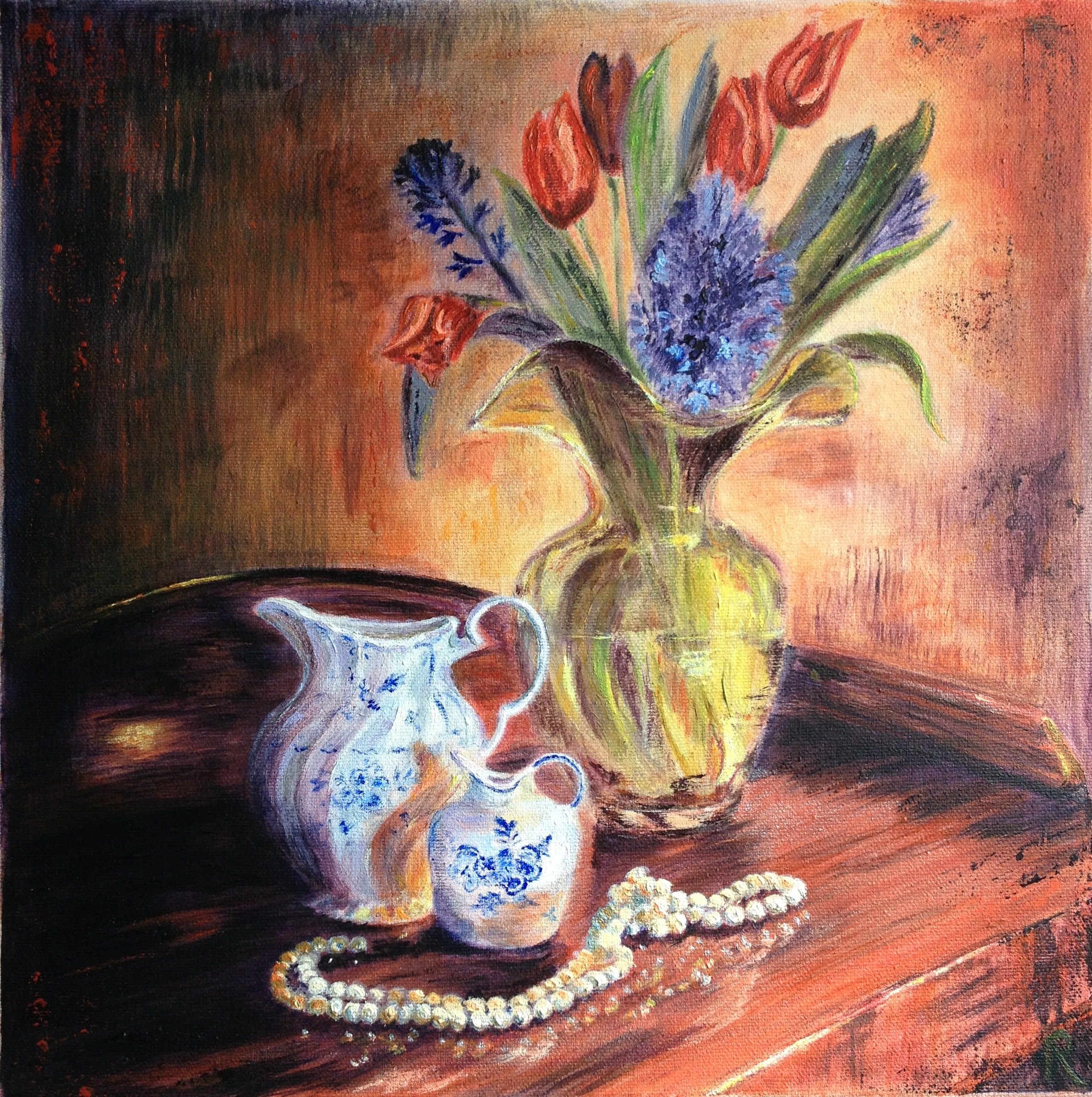
In the above painting the jugs are from a collection of my mother’s, the string of pearls my grandmother’s and the oak cabinet on which they rest from my great grandparents home.  By contrast, the flowers arranged in a mass produced vase offer a metaphor of contemporary ownership, admired for a short time before fading and being discarded to make way for the fresh.

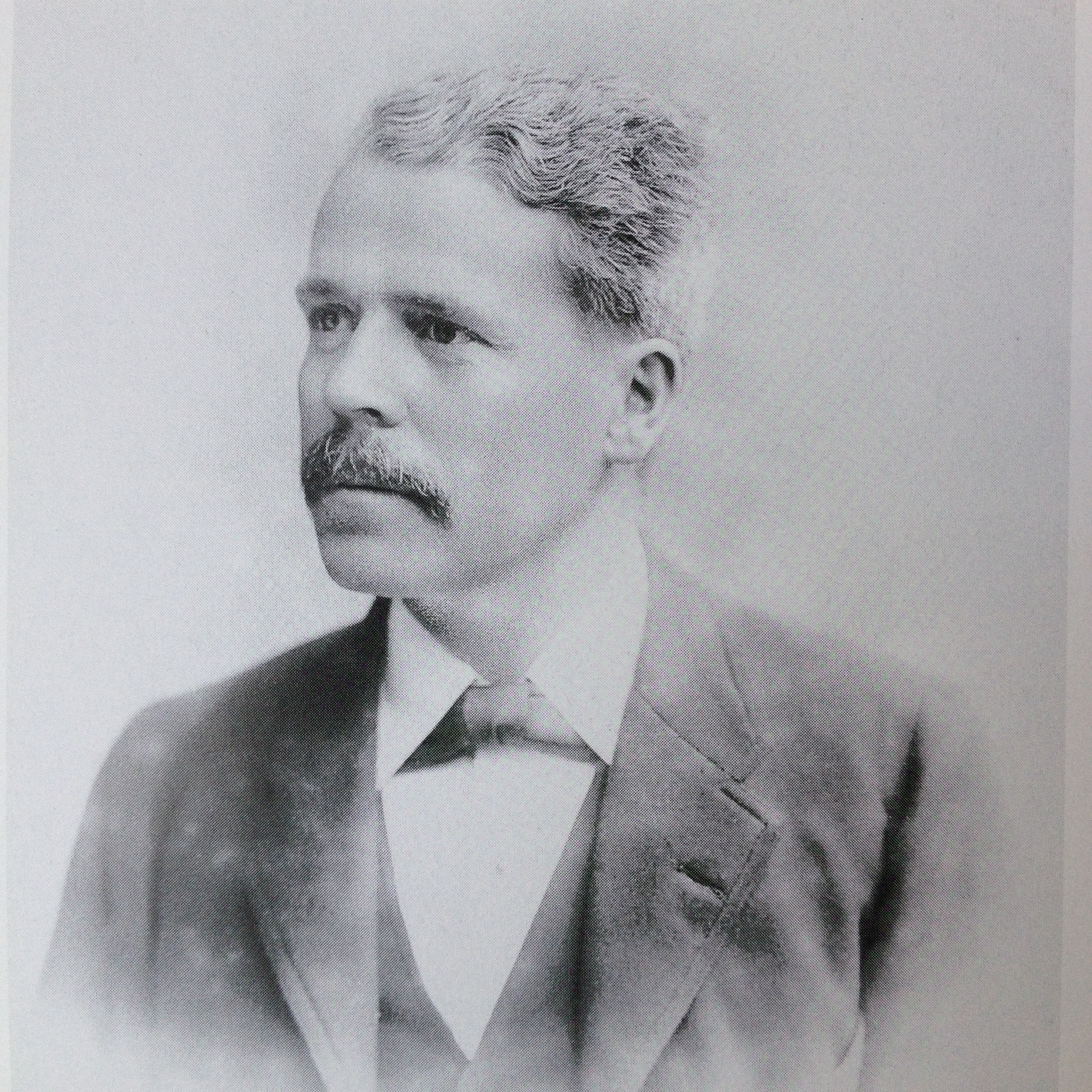
My Great Grandfather Arthur Pells  1851-1927

My Great Grandfather Arthur Pells 1851-1927

Why I look forward to living in a tolerant free society

Tolerant.

A word which has become so commonplace in western society that if the Oxford English Dictionary were listed in order of ubiquity it would appear near the beginning.  It is viewed as something good, worthy, virtuous even – the hallmark of a progressive society.  There is an air of self-congratulation about it because we have managed to suppress something we instinctively feel, in order to promote an outer acceptance.  Politicians and other leaders announce that we live in a tolerant society as if we have arrived at some kind of cultural ideal.

But is it really this simple? To feel tolerant of something you first have to perceive it as different from you in some shape or form, most often the opinion or behaviour of another individual or group.  The term has become synonymous with accepting people from other countries and cultures into the place in which we live and work.  But the very act of tolerating keeps us separate from those we wish to integrate with.  If you feel the need to tolerate, then you are still experiencing a difference from yourself which you feel some discomfort about.  It suggests an element of effort, a ‘putting up with’ for the benefit of the greater good.

Perhaps this doesn’t matter if it enables people to live together in a friendly and cordial manner.  However, the wall of tolerance often serves only to restrain the frustration at having to accept that which our instincts tell us to be wary of.  Under pressure from external stress such as unemployment or lack of resources, these repressed feelings break forth in the form of blame or anger directed at those we previously accepted.  From early humans to modern man instinct has provided a warning to be cautious of strangers and tolerance is merely a sticking plaster covering this innate response and does little to negate it completely.

Genetic Ancestry Tree

Genetic Ancestry Tree

But overcome it we can, as living alongside those from other parts of the globe becomes the norm and over time differences will cease to both us, there will be no tolerance required, no pre-judgement or labelling as to who is friend and who is foe. Historically migration took centuries, the mixing of cultures happened slowly with integration following initial resistance.  My own DNA can be traced back centuries to the North Caucasus region on my maternal side and Germanic roots on my father’s.  At the time of testing in 2009 the closest match on record to my genetic profile was that of a Turkish individual and an Iranian.  It’s not so much that we will end up in one homogenous melting pot but rather than eyed with suspicion, our differences will be embraced.

Already the 21st century has seen a rapid increase in relocation but our instincts, slow to change their habitual response, have yet to catch up.  One day the word ‘tolerant’ maybe obsolete and dropped entirely from the Oxford English Dictionary  . . .  only then will we live in a truly free society.

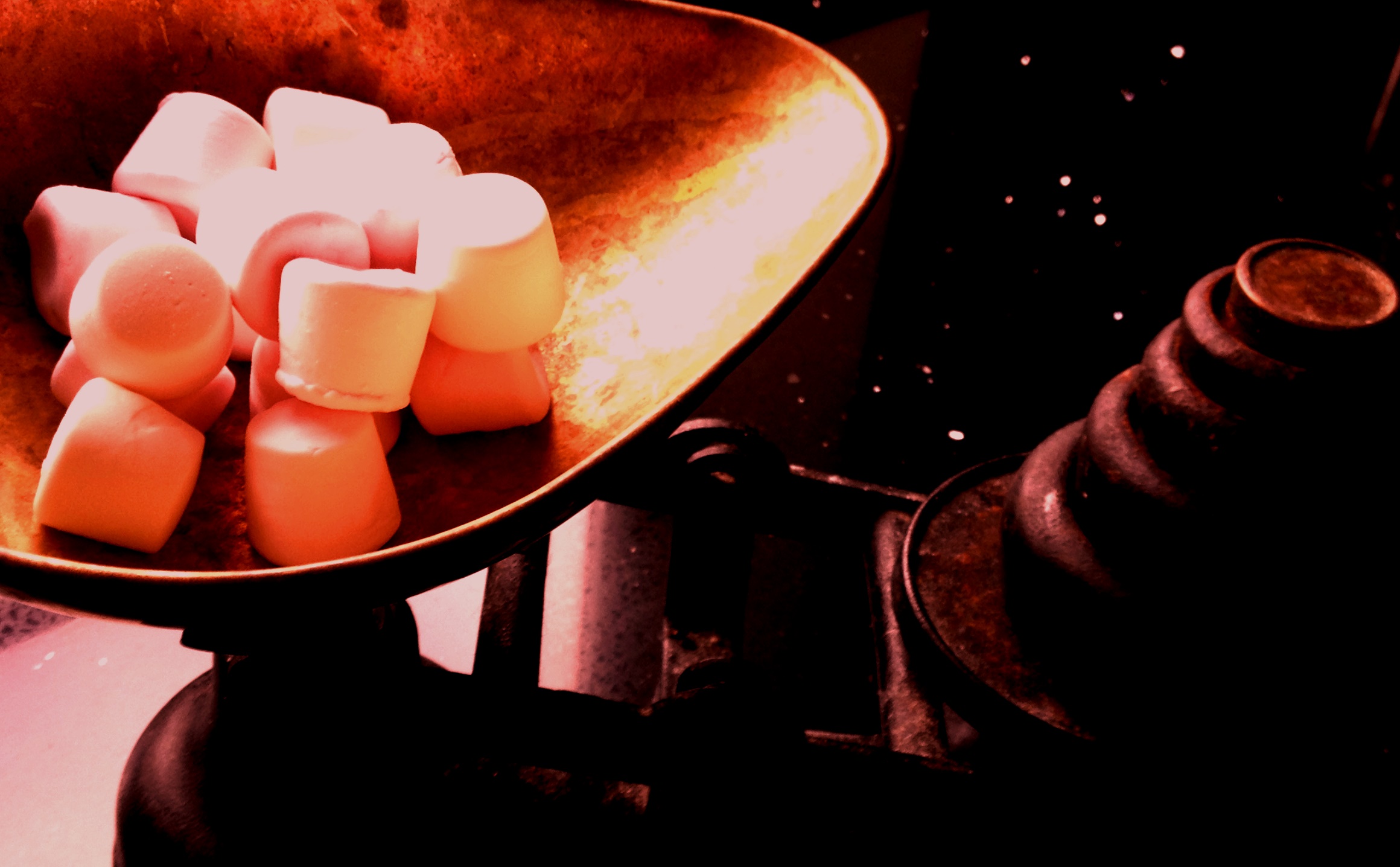
One Marshmallow or Two? The Lost Art of Delayed Gratification

005

A desire indulged spontaneously offers little more than momentary, fleeting pleasure – a treat, whose value is briefly inflated before it melts with a small sigh across our memory.

That which has been anticipated, struggled over and procrastinated against carries within it our best efforts in the shape of an earned understanding.  The resulting fulfillment is part of us, radiating a deep and lasting satisfaction that the sugary goosebumps of a treat can never hope to imitate.

It is more than 5o years since Walter Mischel’s social experiment with four year olds, in which they could enjoy the instant pleasure of eating a single marshmallow or wait twenty minutes and have two. Each child was left alone to make the choice. It was a battle between desire and self-control; gratification and delay.  A seemingly simple tussle and yet the ability to resist impulse is a fundamental emotional skill, the foundation stone of self-control.  The children who managed to wait did so by distracting themselves, demonstrating perseverance towards fulfillment of a future goal.  Follow up studies showed that those who managed to resist temptation went on to lead happier and more successful lives than those who gave into it.

Our capacity to resist is under threat.  Modern life teases, tempts and torments, seducing us into believing that not only must we have the latest phone, the most exotic holiday or the best job, we need to be the first.  We expect to achieve with limited effort on our part – because we deserve it, don’t we?  We have conformed to – and now embrace – an era of instant gratification and our ability to satiate our constant demands has become the currency by which we value ourselves and judge others, the scale by which we perceive our success.  It is the market by which our economy thrives or dives, the treadmill updated from industrial 20th to digital 21st century. Gone are the days when saving up for, or working towards the object of our desire was not only necessary but character building, strengthening resolve, patience and the ability to endure discomfort and disappointment.

 Patience is a word out of sync with our modern society.  We are so used to our desires being  instantly met, that a certain complacency sets in and we struggle to endure the discordant sensations of wanting and lack.  Waiting feels an unreasonable request, we expect it not of ourselves but of others;  so we complain and demand like a two year old whose needs are not attended to.  The planning and  anticipation of fulfillment has become the new addiction, the skin deep ‘high’ satisfying little more than a momentary whim before we’re seeking the next fix.  Lasting satisfaction comes from striving, embedding our heart and soul within our endeavours, elevating the pleasure and value way beyond the instantaneous.

The art of balancing treat and toil is fast disappearing. Let’s refuse to settle for indulgent underachievement and strive for the infinitely more satisfying depths of delayed gratification.

And then enjoy a treat!  One marshmallow or two . . . .

Stove Top Coffee Pot – routinely served and savoured

009

  Each morning I now delight in making coffee in my stove top coffee pot, an unexpected gift which has delivered into my life not just fresh coffee but a fresh routine.  In an age where immediate gratification is demanded and not only the coffee is instant, routine has become an unwelcome word, something to be endured which consumes our precious time and keeps us from more engaging activity.

We associate routine with the ordinary, the familiar and commonplace.  We often perceive and experience it as boring and tedious and try to complete such tasks as quickly as possible.  And in busy lives there is a necessity to undertake them speedily, routine is essential for simple survival.  But through the mundane nature of our toils we may discover something of ourselves.  Routine is the practice of a skill which had to be courted and apprenticed, the harvest of which is the application of confident ability that enables our lives to operate like a well oiled machine.  We undertake our task in the hope that it will take us to a place, some anticipated horizon, where our endeavours may be witnessed, acknowledged and the fruit of our labours enjoyed.

But there is another more intrinsic value to routine.  It supports our emotional well being, our need for a reliable framework on which to hang our daily life.  In times of stress we turn to an activity like ‘putting the kettle on’, the familiar routine distracts, comforts and soothes.  When all around is chaos, routine provides us with a sense of control.  Even those lucky enough to be released from the quotidian of formal work will establish new routines, the joy of freedom soon gives way to the need for an habitual guide to stabilize our life.  The polarities of the routine and the extraordinary support each other and both are necessary to balance the scales of well-being.

The next time routine fatigue sets in, remember that it serves us well – it certainly serves exceedingly good coffee!

007

. . . . and a peaceful New Year . . . .

Peace . . . is something we rarely experience.

Our daily lives don’t provide for peace.  We are surrounded by sound, from piped musak in shops and cafes, to advertisements which blare from screens large and small, to the discordant shrill of a lawn mower and toys which create more noise than the children who play.  An undeclared competition for our attention, it is a background stress we barely notice –  until we remove ourselves from it.  So accustomed are we that the mere thought of silence has become quiet dis-arming.

   Silence separates us from our daily lives and all with which we are familiar; it confronts and challenges us with the uncertain, allowing in thoughts and conversations with ourselves which we have previously conspired to keep at bay.  Quietness is the gateway to the unknown, initially a fearful place to be and just as an addict craves a fix, we look and long for distraction.  Our defense mechanism is to drown out the external commotion by immersing ourselves in a cacophony of our own choosing, a personal aural diet selected from an i-menu of endless options and drip fed through earphones barely visible.

Faced with exchanging sonance for silence even for an hour, many will experience the alarm of impending detoxification.  But as the edge of our discomfort starts to dissolve and abate, so we begin to allow ourselves to enjoy the settling quietness and embrace a sense of relief from the incessant clatter of everyday life.  To be silent is not to become still but to go about our tasks in full awareness and re-discover forgotten pleasures as other senses come alive and we begin to notice details previously shouted down.  Quietness is where we can hide: it is not the tortuous prison many fear but rather a release from a world where our sense of self is constantly diluted and homogenized.

To seek out peace once in a while from an exhaustive world, is to nurture and experience the joy of renewal and growth.  It is an act of independence, a bid for personal freedom and a place of privacy to be cherished and treasured .

063

N.E.W.S – Parallel Time

North. East. West. South.

Instant. Happening. Plus one and real time,

Parallel worlds and lives which don’t chime.

Twenty four seven, channels to choose

Inward we turn, money to loose.

Pools of champagne, pools of blood,

Encroaching. Unwanted. Drought and flood.

Which world is mine in parallel time?

Reality TV talent to spot,

TV for real – someone is shot.

 Christmas delivered, targets to meet,

Harvest failed, kids in bare feet.

Toy penguins emote season’s first frost,

Polar melt – the arctic is lost.

Which life is mine in parallel time?

 Big Brother House. Ok! Hello!

Charnel house, Sierra, Aleppo.

White House secrets outed old lies,

Foggy Jungle King, Malala Peace Prize.

No arms, no legs, no head to crown,

Bloody Sunday; Cyber Monday death in town.

 Which conflict is mine in parallel time?

North. East. South. West.

Lives of celebrities to whom we aspire,

 Suicide bombers few can admire.

Knives quick to draw, turkeys to carve,

Minors in designers . . . others will starve.

Action man sold out. Tragedy! Child cries.

Boy soldier shot. Tragedy. Stumbles and dies.

The choice is mine in parallel time.